
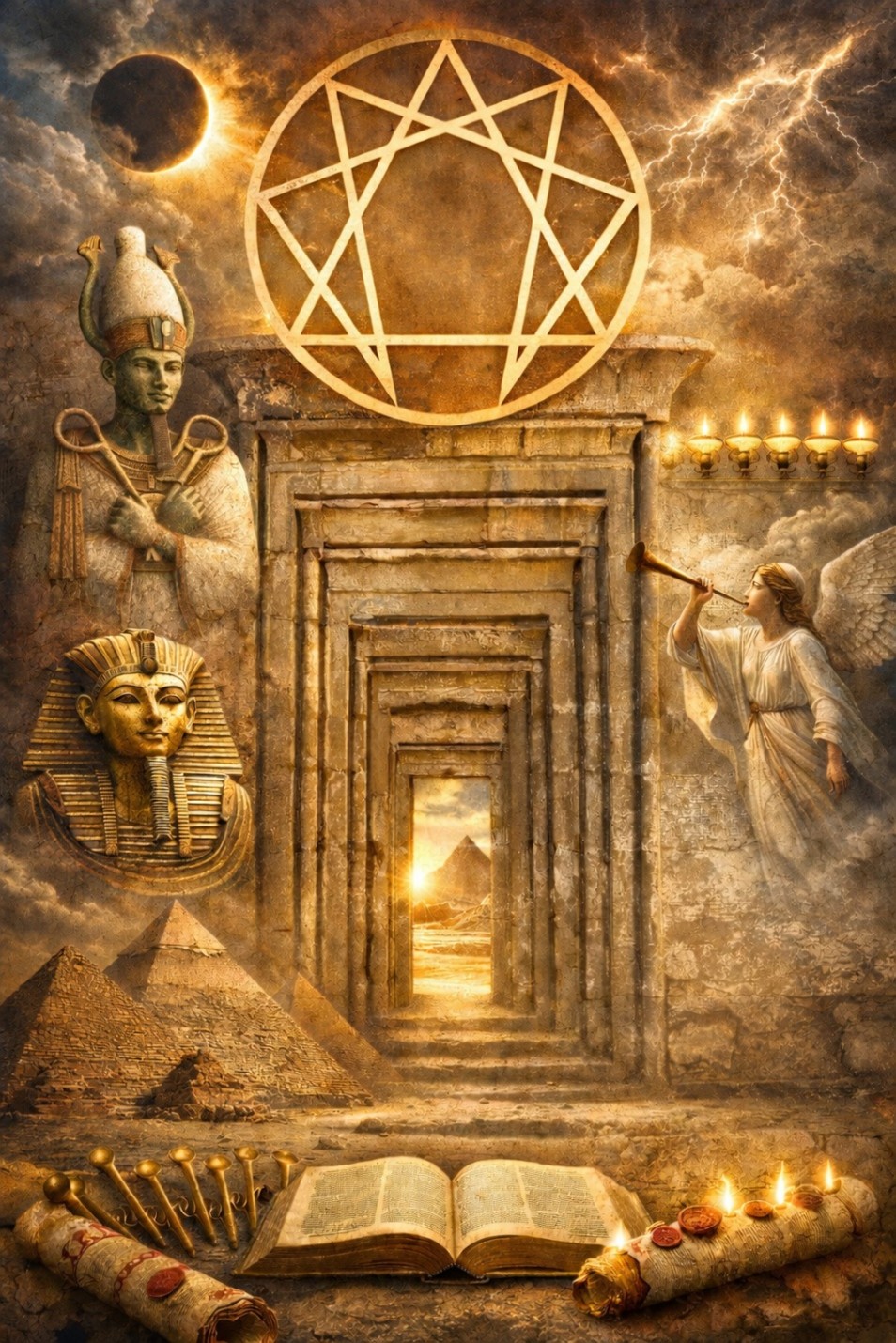
While recently touring Egyptology sites along the Nile River from Cairo to the Sudanese border and searching for symbolic parallels with the Christian Book of Revelation, the temple of Osiris Heka-Djet, or “Ruler of Eternity,” particularly stood out. Osiris was a central Egyptian deity for more than two millennia. Because he was brutally murdered and dismembered by his brother Set and then resurrected by his sister and wife, Isis, he was revered as the god of resurrection and the afterlife, as well as fertility. His mythology is closely linked to death and rebirth, symbolizing hope and renewal. Osiris was often depicted as a benevolent ruler and judge of the dead, overseeing the transition from earthly life to the spiritual realm.
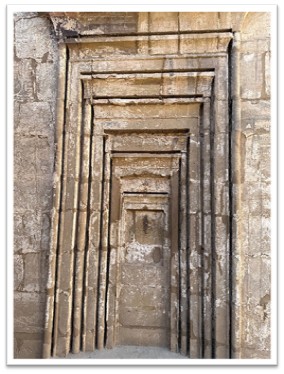
Among the several temples dedicated to Osiris is a relatively small one, dating to about 730 BCE, located at the far eastern end of the vast Karnak temple complex. Because it is dedicated to him as Ruler of Eternity, it features a carved relief of seven doorways nested within one another, as shown to the left.
The seven doorways have been referred to as portals or gates for the six sacred chambers of passage to the afterlife as presented in the Egyptian Book of the Dead. Each chamber is attended by three demonic-looking protectors: the doorkeeper, guardian and herald. The doorkeeper interacts with the deceased to determine whether they know the correct spells, names and declarations required to pass. The guardian ensures that only those judged worthy may proceed. The herald announces the deceased to the divine beings beyond each gate. Collectively, these protectors constitute a functional “triune” facilitating passage to the afterlife.
On the wall in an adjacent chamber is a complementary large carving of seven ankhs, the ubiquitous ancient Egyptian hieroglyph for life, vitality and the afterlife, as shown below. Again, this seven-fold metaphor conveys a plan for a safe and complete journey in the transitional unification between life and the afterlife.
Other seven-fold Egyptian metaphors representing divine protection and guidance for the dead as they complete their funeral journey to the afterlife, though not shown in this temple, include seven uraei, or rearing cobras, seven goddesses of Isis, seven spirits and seven crows. Seven scorpions also appear in multiple texts and inscriptions accompanying Isis in her journey to resurrect Osiris. Additional metaphors based on seven convey a plan for protection, guidance and completeness in transitional journeys for living beings rather than in journeys into the afterlife. These include seven falcons, seven knots and seven representations of the goddess Hathor. 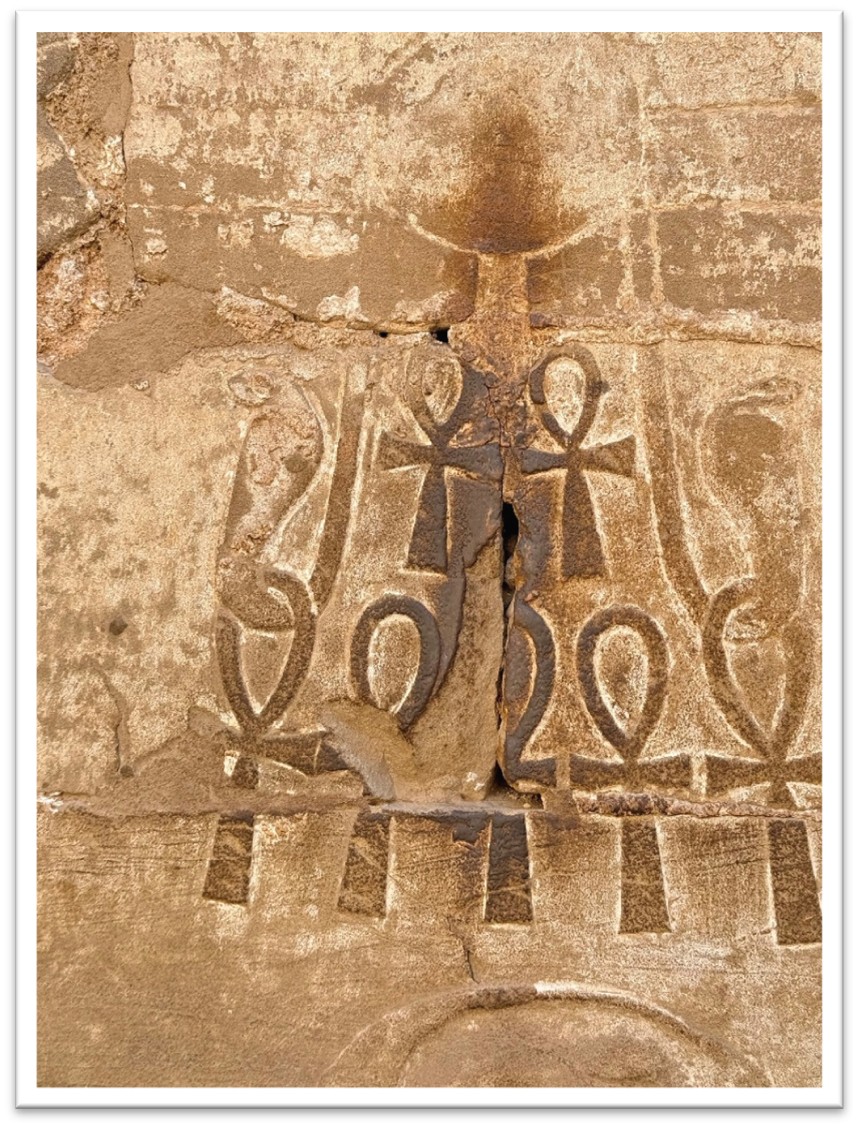
Turning to the Book of Revelation, dated to about 95 CE and discussed in our publication, Uncovering the Apocalyptic Enneagram in the Book of Revelation, we see that it presents a blueprint of God’s plan for humanity to cope with Satan. Somewhat similar to the Egyptology examples above, the book is presented as a journey of seven transitional stages organized into six interconnected series, culminating in emulation of the Trinitarian triune. Literally every phrase is part of a metaphorical mosaic revealing God’s strategic plan to battle and overcome Satan’s capture and isolation of the human personality. The Book purposefully sequences the six series so that they schematically converge as three pairs onto "the triune", as summarized in Figure 3 of the report.
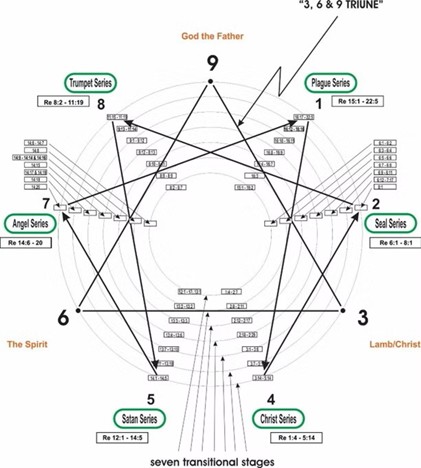 Both the Egyptology references and the Book of Revelation depict plans for humanity framed as journeys overcoming evil influences, structured as seven steps or gates passing through six stages with the ultimate focus of satisfying a triune goal. This journey transcends mystical boundaries by combining human, animal and spiritual characterizations. The roles symbolized by seven, six and three correspond with their Enneagram characterizations, suggesting an evolution of religious thought.
In that sense, it is also notable that G.I. Gurdjieff’s magnum opus, Beelzebub’s Tales to His Grandson, allegorically introduces the Enneagram through an inner journey of human consciousness represented by a spaceship navigating the universe and named after the Karnak temple complex, further linking Egyptological symbolism with the broader Enneagram tradition reflected in FAI’s work. This theme of transitional journeys and triune goals also relates to FAI’s broader Tri-Faith Dialogue work and will be explored further in a forthcoming seminar addressing Jewish, Christian and Islamic views of the afterlife.
