
As an Enneagrammer and an astrologer, I love the music that emerges from the folding and unfolding of the accordion of my practice- the Enneagram on one side of the organ, and astrology on the other. These squiggly symbols, arranged like notes in patterns round a chart that reflect different internal and external conditions— some tense and frustrating, some easy and supportive– are densely packed archetypes with many meanings attached to them that work on various levels of life experience, and release meaning over time in the mind, fertilizing our understanding of ourselves and others. After 16 years of using the Enneagram and maybe 10 using astrology more rigorously, I almost can’t separate the two in my mind, and with a client I am listening for Enneagram typing information with one ear and connecting nodes to their astrological chart with the other. It has only been recently that I realized that I don’t know anyone else who does this. In the astrological world, there has been a resurgence of Hellenistic astrology that places a big emphasis on timing and predictive techniques, but I don’t see anyone teaching us how to read a chart like Carl Jung would have done with his psychiatric patients (unfortunately for us, he doesn't either). And in the Enneagram community, there certainly is an audience for using the two together, but I’ve never seen a methodology laid out for walking through a chart as we would the Enneagram symbol, especially for typing a client with their chart. Why don’t we bring our Enneagram “constellations” to astrology and teach them how to see a personality type in a chart?
For the longest time, I didn’t think it was possible to tell someone’s type by their chart. I always said it was one of the great cosmic mysteries how the 10 planets, scattered about over 12 houses of the chart, always slotted a person into one of nine Enneagram types. And I’m still amazed— every second a baby is born on this Earth, no matter what configuration the planets are making at that moment, that configuration creates an Enneagram type-shaped impression on that soul that connects them to the math that binds us together. This takes my breath away.
However, one day after listening to a lecture on the Moon, I decided to look at the charts of three Type Two’s, just out of curiosity. My jaw dropped. All three of them had their Moon square— at a tense angle to— Neptune. A sample size of three a statistical significance does not make, but what happened in my mind was that I understood what that meant… in Enneagram language. I wasn’t translating from one ear to the other, I was seeing astrology and hearing the Enneagram. I was fascinated, and I subsequently pulled out every chart I could find where I was reasonably sure of the birth time. I have been studying the Enneagram grammar of astrology ever since.
As a Four, I like attention, and I’ve always found it so curiously fitting that I have four planets in Leo, the sign that revels in being the centre of attention. (I also have strong Scorpio in me too, so I do have a dark and brooding side). For this article, I gave myself a challenge: I know how hard it can be to tell the difference between fours and nines sometimes, and I wanted to explore the difference between the two through astrology.
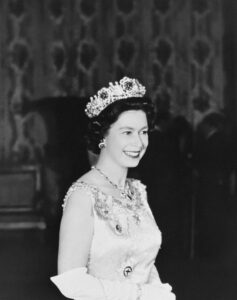
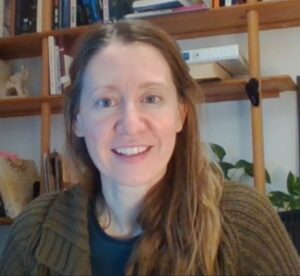
As my test case, I printed off the charts of Queen Elizabeth, a SP 9, and myself, a SP 4, to compare the two. Elizabeth is an actual royal, and although I have four planets in the royal zodiac sign of Leo and think I’m a royal sometimes, I am but a commoner. Both of us occupy positions that go contrary to our Enneagram identity- 9’s identify as the everyman (“I’m nobody special”), and 4’s want people to notice their specialness (“Please don’t remind me that I’m a member of the faceless masses.”)
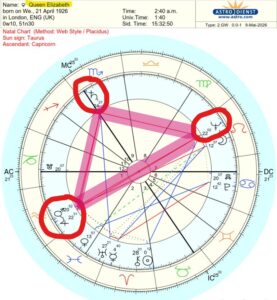
What makes the comparison of our charts a fascinating exercise is that both of us have an almost identical planetary configuration. Central in both of our charts is a large red triangle- this geometric pattern is called a T-square because it’s kind of shaped like a capital T- there are two points that are opposite each other at 180 degrees, and then midway between the two points is a third point that is 90 degrees from both of them. This is fairly common configuration, about 40% of us have them in our charts regardless of Enneagram type, and they can cause a big build-up of tension and frustration, which needs to be dealt with through the apex, the planet at the top of the triangle.
Not only do Her Majesty and I both have these triangular T-squares (highlighted in pink below) with Saturn as the apex, but on top of that, both our Saturns are very close— within degrees— to the top pinnacle of the chart, which we call the “MC”. The MC, or the medium coeli, is the highest point in the sky at the time of birth, the highest point in the chart; it’s the part of our lives that’s most visible to the public, so it denotes our career and reputation. In the Queen’s case, her Saturn on the MC, but still in the 9th house, which denotes meaning, justice, and constitutional law. My Saturn is in the 10th house which relates to my career.
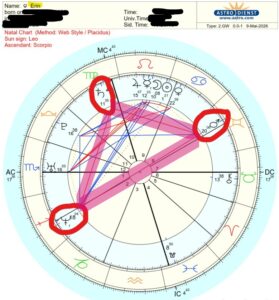
“With such similar compositions to our T-square, how can she be a nine, and I a four?”
Moreover, and this is where things really get interesting, both of our T-squares have Mars and Neptune as the opposition planets, although granted, they’re on different sides. The other difference is that the Queen has Jupiter conjunct her Mars, whereas I have Jupiter sextile my Mars, but either way, both of us have Jupiter supporting the Mars side of our oppositions. With such similar compositions to our T-square, how can she be a nine, and I a four?
But let’s zoom out for a second. We don’t need to get into the weeds just yet.
Right away, before even looking at the T-square, some things jump out at us in her chart- her sun is in the lower half of the chart, which means she was born at night. Nines have an aversion to the sun because the sun is the planet that enables a person to feel special. Think about your birthday- when the transiting sun has returned to the original place of your birth in the chart- that is free attention that you don’t have to earn, so it’s the best kind. As an administrative assistant who was in charge of birthday arrangements for the staff, I was always disappointed – and flabbergasted – when someone took their birthday off from work. “To do what??” I wondered. “Work is where you come to get attention on your birthday!” Leos like to be in the spotlight, but we also love to give the spotlight to others (even though as a Four, yes, envy is always in the shadows, nipping at my heels about something). So Nines will often tend to have their Sun in either the lower half of the chart or connected somehow to Aquarius, the 11th house, or its ruler, Uranus, where it’s in detriment. For those of us in the camp of Obama being a Nine, his Sun is in Leo, but it’s below the horizon hidden in a less powerful house, and it’s being squared by Neptune, which leads us to our next important planet for Nines.
Neptune is the planet of dissolving boundaries and identity-lessness, and like the Queen, Nines often have Neptune connected to the 7th house of how we project onto “the other”- either Neptune is in the 7th house, or “conjunct” (sitting with) or “aspecting” (looking at from a particular angle) the 7th house ruler. Because of how predominant merging is for a Nine, Neptune is a pretty important planet for them (also for Threes and Sixes, but for different reasons.).
The fact that the Queen’s moon is also in the 7th house only strengthens the case that the 7th house is a place of receptivity from “the other”, as the moon reflects the light of the sun in others. As astrologer Israel Ajose says so beautifully about the transiting Moon, she travels from planet to planet, bringing sense impressions from one to the next. “She’s the gatherer, she’s gathering … an experience and she’s bringing it along with her, it’s in her bag.” This gathering works with relationships too- the moon in a Nine’s chart collects impressions from others and puts them in her bag. We haven’t yet gotten to the part where we find out what Moon and Neptune are doing with what’s in that bag - a Two could easily have their Neptune and Moon in the 7th, or a Nine could have their moon in the first house, or in another house- but we’ll get there.
Another flag that indicates we might be dealing with a Nine is that their North Node might be in or at the entrance to the 7th house. The North Node is a point that shows what we’re addicted to in this life- and when it’s conjunct a point or planet, that addiction gets extra suction power. In the Queen’s case, with her North Node being right at the entrance to her 7th house, she was hungrily gathering sense impressions by virtue of her tuning into “the other” so strongly.
However, 9’s can only merge so long before they then need to oppose the very person they were merging with a moment ago! An 8w9 friend of mine doesn’t go around expressing opinions like I do, and they’re mysteriously not fully formed until he hears mine, at which point, he immediately knows what he feels about the issue- it’s the exact opposite opinion to mine. In our 12-year friendship, I don’t think we have ever agreed on a single topic of debate, and I have a sneaking suspicion that it’s my anger about something that gives him the impetus to be angry about it too, but in an opposite way. Once, I (rightly or wrongly) got mad at a type 9 manager for letting his staff disappear with expensive technology equipment during the pandemic, and I went to his office with some angry words. 45 minutes later, he had rounded up his friend and they came to my desk with the same angry clouds on their faces as I had, only they were mad that I was sitting in a grey chair whereas the rest of the office was sitting in aesthetically-coordinated black chairs. They made me give my chair up because it didn’t conform and I had to sit in one of the uncomfortable black chairs until our black chair supplier backed me up. So the two biggest “stopping” planets that will stop that merging and attempt to grab back the projection to crate solidity within oneself are Saturn and Uranus. The Queen, represented by serious Saturn herself is squaring her merging planet Neptune saying, “Yeah well, I’ve gathered your sense impressions, which have helped me figure out my sense impressions, and now I’m pushing back to differentiate myself from you”. The solid physicality of Saturn will put the brakes on that merging, (but so will Uranus in, or at the entrance to, the 7th house, or in some way aspecting the 7th house ruler with a tense aspect.)
Now we have arrived at Saturn, the apex of this tense T-square. Saturn is the stormy god Kronos of Greek mythology, the timekeeper, the disciplinarian of the sky who kicks the foundation of our lives to make sure nothing is faulty and if it is, he will kick it all down and make us rebuild it from scratch. As a connoisseur of pain, I have made Saturn a subject of much study, and I have empathy for anyone who suffers from such a difficult taskmaster as he.
So with grim Saturn at the top of Elizabeth’s triangular prison, he acts as a prison guard who prevents her from accessing the planets in her opposition until she goes through him first. That means integrating Saturn’s qualities is a requisite to being able to access her Mars, Jupiter or Neptune along the opposition. So the Queen – represented by Saturn itself -- has to work to create the container in which Neptune can produce what it is inherently capable of producing, which in her case is value, because Neptune rules her 2nd house of self-esteem. But because it’s a lifetime’s work to develop the apex planet, we usually end up just giving in to its bullying throughout life, walking around like he’s leading us around through a ring in our noses. In Enneagram terms, this configuration would translate as sloth (Saturn) to one’s value (2nd house).
We’ve only looked at the meaning of her Neptune on the right side of the opposition, now what about the Mars and Jupiter on the left side? Through a Placidus reading of this chart— a house system that is excellent for character analysis— Mars and Jupiter also both represent her sense of having value. (Jupiter is one of the two rulers of Pisces, which is the main ruler of the 2nd house, and the intercepted ruler of the 2nd house is Mars). So all three planets that she is restricted from accessing on the opposition represent a sense of having value. Now, I don’t know the Queen, but I know what the paralysis feels like to have Saturn as the apex of a T-square. It results in a lot of kowtowing to an authority bigger than ourselves, and ironically, with Saturn being her, she was the authority that was bigger than herself. Yes, she brought the Commonwealth together and played the everyman with the endearing humility of a Nine, but with Saturn as her avatar, she also embodied the hilarious-if-not-painful irony of the type 9 politician: “Who am I to have values and impose them on people? And by that token, who are you?” If anyone knows a Nine in politics, they tend not to get fired up by an opinion, but by the dousing of fire out of others’ political opinions; the opinions being the value impressions she is gathering from Neptune in the 7th house and immediately extinguishing with her Saturn.
So far, we’ve only talked about the Queen and we haven’t compared my chart. Well, here’s the short answer— a similar drama with the same actors, but different script is playing out in my chart, but this time using planets and houses that connect with the vertical 4th house-10th house axis. The Queen’s type Nine complex ran along her 1st and 7th house axis— the self vs the other, with big players ruling the 2nd house of value. By contrast, the theme of the Four’s 4th and 10th house axis is moreso that of emotion versus one’s life purpose and our public persona, so our chart tension is more often connected to the fourth house (emotions, home, family, parents) and its ruler, the Moon. For short, I’ve got a 1-10-4 signature in my chart whereas Elizabeth has a 1-7-2 signature.
This has been a lot, and if you have smoke coming out of your ears, that is understandable, and I give you kudos for getting to the end. My goal was to show what was possible for us to delineate, as interpreters of sacred symbols, from the starry skies. But I want Enneagram therapists and coaches to know that we can be effective even with a beginner’s knowledge of astrology because we are letting our curiosity and the client guide us (I have more examples how we can use astrology in counselling here). With the advent of TikTok and Instagram, and the recent profusion of astrology apps, our clients know more than they ever have in human history about their astrological charts, and I believe it benefits all of us to be able to follow along a simple astrological delineation that a client might bring us. But more than that, I particularly think Enneagram coaches and therapists are uniquely suited to read these ancient hieroglyphs in a way that’s deeply meaningful and empowering for their clients. To that end, I’ve created a five-week course to demonstrate how to use basic Astrology alongside the Enneagram, and how to figure out someone’s type using their chart. This rare course begins soon: Saturday, June 6, 2026, so sign up today! The description and tickets are on my website.
