
For a long time now, I have been obsessed with trying to understand the relationship between Evagrius’s ancient demons (catalogued by him as eight logisimoi: Anger, Pride, Vainglory, Sadness, Avarice, Gluttony, Lust, and Acedia) and the passions of the modern Enneagram (arranged on the Enneagram symbol by Ichazo: Anger, Pride, Vanity, Envy, Avarice, Fear, Gluttony, Lust, and Sloth). If you haven’t met Evagrius yet, or heard about his eight logisimoi, you really must: he is basically the father of the Enneagram, or at least that’s how I think of him. Evagrius was one of the wave of men and women who moved out of the cities and into the desert in the 300s, trying to find a new way to live and love. In Evagrius’s time, Christians who fled the cities to seek God met and learned from natives of the desert who possessed generations worth of knowledge about how to survive in their extremely harsh environment. For the Christians, demons were theoretical, a concept that had been developed as part of Greek philosophy. For the desert natives, demons were entities that could and would physically harm you. In the years that Evagrius lived in the desert, praying, teaching, and writing, he gradually integrated these two different knowledge traditions into a theory and practice that focused on logisimoi, or “evil thoughts”. Evagrius identified and described the logisimoi in great detail. His list gradually evolved into the Catholic Church’s seven deadly sins, and also served as the basis of the modern Enneagram, but that is another story. The terms “demons” and “evil thoughts” were basically interchangeable for Evagrius, while for us, in the modern world, they are most definitely not. If I tell you that I am writing a book about the Enneagram and demons, you will probably look at me sideways (or, if you don’t, I will probably look at you sideways – do you actually believe demons exist?!) But if I tell you that I am writing a book about the Enneagram and evil thoughts, you might ask what I mean by “evil”, but the concept of “thoughts” is probably not going to alarm you. If anything it will probably bore you. Evagrius believed that the physical world had been created to serve as a “book” that humans could learn to read, and by reading, learn about their true nature. Evagrius spent a lot of time observing himself and the other humans around him, trying to understand why they did what they did. Why did people, including himself, come into the desert with the intention to pray and contemplate God and then just leave? Or fall asleep? Or get in a fight with another monk? Why? And what was to be done about it? Evagrius developed an awesome body of work around these questions. Evagrius explained that originally, all that existed were “intellects” hanging out in perfect contemplation with God. It was bliss. But then, for some reason, the intellects started to slip away from this perfect state. The intellects who had fallen furthest away from contemplation became demons, the intellects who fell partly away became humans, and the intellects who stayed closest to God became angels. Jesus was the only intellect who didn’t fall away from God at all, but that’s a different story. So that’s the set-up. Evagrius believed that ultimately all the intellects would return to perfect contemplation with God. But in the meantime, humans are in a precarious position. The demons have fallen furthest from contemplation with God and they can’t even image angels. They can only observe human behavior. And their intention in observing humans is to understand everything about them in order to deter humans from returning to a state of contemplation with God. That’s all they want to do, keep humans from learning their true nature and returning to a state of contemplation with God. Evagrius described how the demons use their formidable observational skills to study humans relentlessly, and to figure out what situations and experiences will distract humans the most. In Evagrius’s world, demons are continually observing humans, devising strategies for distracting them, observing the results, and refining their methods based on what works and what doesn’t. At the core of the demons’ methods are thoughts. For example, if a demon determines that a monk will get thrown off by anger, the demon might point out to him that “his cattle aren’t walking in a straight line” and will go on to point out how upsetting this is, how wrong it is that the cattle aren’t walking in a straight line. And pretty soon, the monk, if he is having a bad day maybe, will find himself enraged at the poor cows, screaming at them, screaming at the other monks who try to help him. And screaming at himself for getting angry in the first place. Or take another example. A monk completely understands and believes that his vow of poverty is important. Maybe he took the vow when he came to the desert, gave away all his possessions, and entered a new life based on trust that God will provide for him. The monk understands that this vow is a core part of his commitment to give himself fully to contemplation with God. But then one day a demon points out to him that while of course his vow of poverty is really important and all, can he imagine how awful it would be if he fell sick, and became a burden on the other monks? The other monks have also taken vows of poverty that are sacred to them. They have nothing to share. And if the monk falls sick, he would put his brother monks in peril if they had to care for him. So it really might be better if the monk just sets aside a little extra, nothing much, just a little extra, just in case something should happen… And then the monk all of a sudden finds that he has broken his vow of poverty, and is hoarding food or money or water. And he feels ashamed, and yet, it seems so important… It’s like that, all the way through the list. This is where the Enneagram as we know it began. Sitting with Evagrius in the desert, watching how humans behave, talking with people about their suffering. Offering advice sometimes, in a very gentle, roundabout, humble way. Seeing how the advice played out – did it help? Did it make things worse? Evagrius contemplated humans and their suffering, and out of that contemplation he developed a cosmology of demons and angels and humans and God and Jesus. It is a great story. It is compelling, and coherent and it actually helps me a lot, when I am having troubles, to think of myself and my world and my suffering the way that Evagrius would have seen it. ********* When I tell you that I am a Type 6, I am telling you that I have observed in myself a somatic-affective-cognitive pattern that I believe is a product of interactions between my genetic makeup and my environment, especially my social environment. I believe that these patterns go so deep that they have become trait-like in me. When I am having a Doubt attack, the somatic-affective-cognitive pattern is so strong that it feels like something is happening to me from the outside. Thinking about it in terms of demons makes a hell of a lot more sense in those moments than thinking about it in terms of patterns that I developed as an infant in order to ensure proximity to my mother. But when I am not having a Doubt attack, I know that I need things to make sense in terms of the Theory of Evolution. And evolution is not intentional. So I am obsessed with finding something that has grown out of evolutionary theory, something that is not intentional but provides the same explanatory power and coherence as Evagrius’s logisimoi. ********* Recently, I came across something Antonio Damasio wrote about Freud. Damasio is recounting a story in which Einstein writes to Freud to ask if Freud thought there was any hope for humans. Freud answered, “not really”. Damasio believes that Freud’s pessimism grew out of what Damasio describes in humans as an “unrestrained triggering of a specific set of negative emotions, their subsequent disruption of homeostasis, and the overwhelming havoc they cause on individual and collective human behaviors.” When I read this I thought, “Oh, Damasio has found the demons!” “the unrestrained triggering of a specific set of negative emotions, their subsequent disruption of homeostasis, and the overwhelming havoc they cause on individual and collective human behaviors.” To me, it seems obvious that Damasio is perfectly describing, in neurobiological terms, what Evagrius was describing in terms of demons. I believe that Damasio is describing what was going on inside the monks when they experienced themselves as being attacked by demons. But Damasio understands this “unrestrained triggering of a specific set of negative emotions” as an unfortunate side effect of the evolution of consciousness, not as something that evolved because it served an adaptive purpose in itself. A bug, not a feature. Evagrius believed the opposite, that the demons were an essential aspect of the human condition who served the purpose of enabling humans to learn about their true nature. A feature, not a bug. I am looking for something that can reconcile these worlds. ******** Evagrius saw a monk screaming at cows because they weren’t walking in a straight line. He understood what was happening in terms of an interaction between the monk’s intention to be in a state of contemplation with God and a demon’s intention to keep the monk from that contemplation. Damasio observing this monk would say that the monk was experiencing an “unrestrained triggering of a specific set of negative emotions”. What would my understanding be, from the perspective of the modern Enneagram? I would be thinking the monk’s attention was being drawn to focus on everything that was wrong with the situation. And that this focus of attention on error was causing the monk to fall into a state of physical, emotional and mental dysregulation. I would also assume that this particular monk, when he was very young, had unconsciously learned to focus on error, as the best possible way, available to him at the time, of having any hope of returning to a state of love. What I would be seeing and thinking and feeling would be rooted in my understanding of the Theory of Evolution, and Attachment Theory, and Affect Regulation Theory, and Mentalization Theory, and my own years and years of observing myself and talking with others about our troubles. My understanding would still not be complete. I am still obsessed. But I am getting close. I know it. ********* Sources Affect regulation, mentalization, and the development of the self by Peter Fonagy, György Gergely, Elliot L. Jurist, and Mary Target, Other Press, 2005 Affect regulation theory: A clinical model by Daniel Hill and Allan N. Schore, W.W. Norton & Company, 2015 Demons and the making of the monk: Spiritual combat in early Christianity by David Brakke, Harvard University Press Desert Christians: An introduction to the literature of early monasticism by William Harmless, S. J., Oxford University Press, 2004 The Enneagram: Understanding yourself and others in your life by Helen Palmer, HarperCollins Publishers, 1991 Hidden in plain sight: Observations on the origins of the Enneagram by Virginia Wiltse and Helen Palmer, in The Enneagram Journal, 2011. Mystics by William Harmless, S. J. Oxford University Press, 2008 The Sapphire Light of the Mind: The Skemmata of Evagrius Ponticus, by William Harmless, S. J. and Raymond R. Fitzgerald, in Theological Studies, 2001. The strange order of things: Life, Feeling, and the making of cultures by Antonio Damasio, Pantheon Books, 2018 " target="_blank" id="new">
For a long time now, I have been… |
Eights, Nines and Ones usually have no inherent trouble with action. Instead, they tend to unconsciously overlook themselves and habitually… |
To paraphrase the Beatles:
|
Eights control through lust which includes sexual lust, but encompasses a lust for power, a drive to dominate and prevail.… |
Connection is the heart of the Enneagram. From the living symbol, to awakening awareness, to transformation, the wisdom of the Enneagram invites all of us into a life-giving process. The dots and lines of the Enneagram are brought alive by connection, when this unique wisdom is passed on from one life to another. For centuries, this wisdom has been passed on through word of mouth and conversations, from person to person. With this dynamic in mind, a new opportunity is being rolled out to encourage and promote connection and learning from each other. This new opportunity is called EnneaGroups, an experimental new IEA membership benefit. EnneaGroups are small group gatherings — online or in person, open or closed in membership — around a particular topic of interest and for a time and duration set by the group. Each EnneaGroup will have a facilitator who will act as a point-of-contact with the IEA, and each EnneaGroup will have flexibility to set its own purpose and dimensions. The spaces can take a variety of forms, using FaceBook, or other social media platforms, video-conferencing, or meeting in person. The goal is to create spaces to connect and learn from each other across a wide spectrum of topics and interests. Some examples of topics around which a group could form: · Spirituality · Secular/Business · Research · Coaching · Location-Memphis, Vancouver, Oakland, Austin · Parenting · Teaching & Education · Type 2’s · Latinx · (Insert Your Idea Here) This new IEA member benefit will offer a variety of ways for you to be involved. Over the next coming months, There will be opportunities for you to be a part of creating these EnneaGroups spaces. We will need input on your interest and ideas for forming or being a part of these groups. We will need help organizing and offering leadership to the groups, once formed. There will be resources available through the website and from the EnneaGroup leadership team to offer support however you choose to be involved. If you want to get involved with group leadership, there will be facilitator training available. The two-dimension symbol of the Enneagram is brought alive by the connections it invites. We need each other for the full expression of the essence of all nine types. We need this kind of connection. The world needs this kind of connection. This energy can be contagious as we connect in relationships and personally transform. Look for more information to come on the IEA website, Nine Points, And at the IEA Conference in Oakland, July 25-28. The EnneaGroup leadership team includes Trent Thornley, Curt Micka, and Mike Block. You can email your ideas and questions to enneagroups@internationalenneagram.org. " target="_blank" id="new">
Connection is the heart of the Enneagram. From the… |
Spiritual traditions generally portray the ego as a barrier we place between ourselves and… |
This article originally appeared on greaterlight.ca. Although your Enneagram type is not your final destination on… |
This article was originally posted on greaterlight.ca. The Enneagram is having a bit of a moment.… |
In his book, The Enneagram Spectrum of Personality Styles, author Jerome Wagner presents a list of each Enneagram style’s strengths… |
After a recent Head Type panel, a student said, “My partner is a Five. I’ve been reading everything I could… |
Swiss therapist Marie Louise Von Franz was once lecturing about applications of Jungian psychology. She was saying that most women… |
Communication loops are necessary to provide feedback within an organization between individuals, involving a critical assessment of an individual’s behavior… |
This article originally appeared on greaterlight.ca.
|
“Type or ego is simply our strategy for surviving on planet earth” Dr Deborah Ooten, School… |
Beyond our biological need for identity is the desire to know who we are in a deep, personal sense. Each… |
There is an organization called The Flat Earth Society whose purpose I used to assume was tongue-in-cheek. Through its literature… |
Those of us who want to identify our Enneagram types correctly, as well as those of us who guide others,… |
[1]. It is possible to go to either point connected to your type, either consciously or unconsciously and take on either the best or worst of that type – it’s your choice. Abi Robins has renamed the stress and security points refuge and vantage (derived from a concept by Frank Lloyd Wright) and has described how you can access each of these points consciously or unconsciously.
-->
Leslie Hershberger has also pointed out on Twitter that the stress/security dynamic is not enough – that you must develop an inner practice to make use of the Enneagram. https://twitter.com/LeslieHersh/status/1126085944107503616
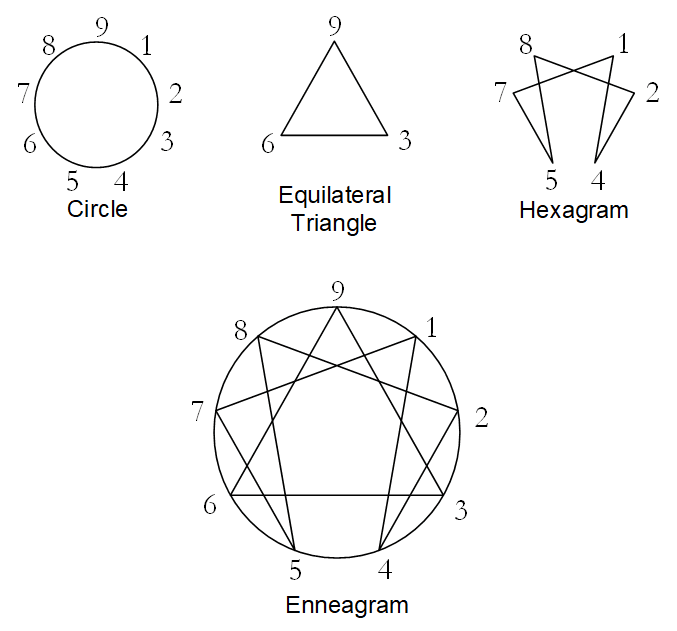
Going Beyond Stress and Security If you want to use the Enneagram for spiritual practice, it helps to understand the laws of the Enneagram, which take inner development further than the stress-or-security dynamic. The three components of the Enneagram – the circle, the triangle, and the irregular hexagram – each represent a principle or law that describes the way that Spirit interacts with us in the world.
The circle represents the Law of One – the union and unity of all things, the idea that our separation from God and from each other is an illusion. The triangle represents the Law of Three, which describes how two different ideas, feelings, or actions (forces) can be held in tension. When we do this contemplatively, we invite a third force that transcends and includes the other two. The irregular hexagram symbolizes the Law of Seven, the “processing numbers” of the Enneagram, the way that we deal with the unexpected impacts of the world on us. The Law of Three The triangle of the Enneagram joins the three centres of intelligence – Gut (8-9-1), Heart (2-3-4), and Head (5-6-7). Head knowledge on its own will not bring spiritual transformation, nor, on their own, will practices that open the heart or ground the physical body. Any practice that uses the Enneagram for personal and spiritual growth must address all three of these centres.
The Law of Three manifests throughout the Enneagram in all spaces, not just the 3-6-9 points of the inner triangle. Each space has its way of operating in the world described by the affirming, denying, and reconciling forces of the Enneagram domains. It is through the Law of Three that heaven and earth meet, as the affirming and denying forces hold space for Spirit to drop in via the reconciling force. But how do you do that? You can learn to navigate the polarities of each space via the Law of Seven, which incorporates thought (FIVE and SEVEN), emotion (TWO and FOUR), and action (ONE and EIGHT) from the hexagram points of the Enneagram. This happens no matter which space on the Enneagram you identify as your personality type. The Law of Seven The irregular hexagram represents the Law of Seven. The construction of the hexagram derives from the sequence of numbers generated by the fraction 1/7. Try dividing 1 by 7 on a calculator. The result is a repeating decimal. The calculator displays 0.142857142857, repeating as many times as the displayed digits will allow. (There may be some rounding involved, but we can ignore this approximation.) We can write the number sequence as 0.142857…, indicating that it repeats indefinitely. Lines joining the points 1-4-2-8-5-7-1 in this order generate the hexagram figure.
The Law of Seven governs how we process a reaction to something that upsets our equilibrium. We face many impacts from the world every day. So much sensory, mental, and emotional material is coming at us that we have to pick and choose what to pay attention to. When we cannot avoid some impact – an unkind word, a frustration, a shameful thought, an injustice of some sort – the Law of Seven kicks in to deal with it. Consciously and Unconsciously Following the Law of Seven Reactions are meant to wake us up. However, if I approach my reaction unconsciously, I end up going “down the drain”, following the numbers of the inner hexagram one after the other. · ONE: I react to the impact from the world. I feel this in my body as tightness, nausea, heat, paralysis, or something else that I perceive to be negative. I feel resentful of this reaction. · FOUR: I reject my reaction, refuse to own it. I want an experience other than the one I am having. · TWO: I refuse to honour my own experience. Either I ignore it or I fixate on what I perceive to be someone else’s experience of the situation. · EIGHT: I respond with anger, possibly lashing out at the source of my reaction. · FIVE: I withdraw, refusing to engage with the world. · SEVEN: I brush off the experience (“I’m fine!”) and distract myself without engaging the source of my reaction. This cycle repeats, hardening and intensifying with each round, until I become so identified with my reaction, I can’t imagine any other response. Working through the same path consciously, I can process a reaction more productively. · ONE: I notice the reaction and I am grateful that it woke me up. · FOUR: I can enter and fully feel my reaction to my experience as an emotional response, such as sadness, anger, fear, or shame. I meet my reaction with an inner knowing and clarity. · TWO: I honour my reaction, relate to, and care for it. · EIGHT: I surrender to what-is. I let go of my desire for vengeance. I submit my will to the greater will. · FIVE: I seek to express my own voice. I detach from judgment and see my situation as it is without needing to change it. I engage with others to move forward. · SEVEN: I am fully present to my experience and open to something new in the situation. I include everything and everyone, having consciousness with heart. This sounds very enlightened and idealized, but it can be really hard to do. Noticing and feeling my reaction does not mean I have to like it. Surrendering to what-is and detaching from judgement does not mean I have to let myself be walked over. None of this takes away the pain and difficulty of a crappy situation, but by acknowledging the suffering inherent in the situation, it is possible to avoid unnecessary suffering. I bear what is mine to bear, but no more. An Example: Reacting in the NINE Space During my spiritual direction training, I had an experience that illustrates how the Law of Seven can process a reaction, positively or negatively. As part of the training, each of us was paired with a colleague to practice spiritual direction with each other for a couple of short supervised sessions. I walked in thinking, “Well, how hard could this be? I’ve been seeing a spiritual director myself for a few years. It’s just from the other side.” It turned out to be harder than it looked. I felt responsible for “making” something happen in the session rather than just listening. I kept prodding my colleague – a FIVE – for some kind of response. She responded by withdrawing. The rules of the session allowed either party to stop for a break, a clarification, or to debrief. My partner stopped the session, saying she felt very “directed” and that she was just “answering questions”. I panicked a bit. We kept going, but my confidence was shaken. The virtue of my Enneagram space (NINE) is action, or more specifically, right action or essential action. The flip side is that action, if it is not essential, can be a way of going to sleep. I can get so caught up in “doing” something that I have no time to attend to what really matters. In this case, I had focused so much on making sure the session was going to work and hoping I would not look foolish that I fell asleep to what was actually going on in the room. It was more about me feeling (and looking) competent than offering a listening ear. I reacted to the practice session with a sense of despair and failure (ONE). I was about ready to quit the whole program and was feeling sorry for myself, hanging out rather morosely in the FOUR space. I did not want to have the experience that I was having. At lunch, I thought everyone else had had a better practice session than I did. Then they started talking about their first silent retreats, and they’d all had better experiences than I had at that, too. And they told better stories. I did not really participate in the conversation, feeling that I had nothing to say and that their experiences mattered more than mine did (TWO). I nursed a little anger (EIGHT) toward my practice partner for being so impenetrable. I withdrew (FIVE) for the rest of the day and spent the evening in some distracting activity (SEVEN). In the next day’s morning practice, we began with a lectio divina (sacred reading) on the parable of the Good Shepherd in the Gospel of John. I was struck by the word “voice” in the phrase, “My sheep hear my voice.” During the morning teaching session, I wrote down, “A time of contemplation leads to a change of consciousness and a change of understanding.” I was still holding on to my reaction from the previous day (ONE), but I was ready to own it. I allowed myself to go into the depth of the experience of inadequacy and really feel how it felt not to be up to a task that I thought I should have been able to do (FOUR). We had time in the morning to do a walking meditation. It was a windy day. Taking care of my own needs and relating in a heartfelt way to my own experience (TWO), I went outside and surrendered myself (EIGHT) to the different “voices” of the wind. I climbed the bluff overlooking the lake and just listened to the different sounds for a while. Later, I wrote in my journal,
When I returned to the building and went into a second practice session, I was able to carry that experience of listening (SEVEN) and the session went much better. So, paradoxically, the busy-ness in the first session was all inessential action. In the second session, the listening (“doing nothing”) turned out to be the essential action. Reactions in the Unawakened and Awakened States In the unawakened, or egoic, state, I think we have some vague sense of what the awakened, or transformed, state of our souls would be, so we try to replicate it somehow. But the ego has no tools for operating in the transformed state; it must operate in a limited version of reality. Personally, my ego sees that the task of the NINE is to wait consciously, and then move forward with right action. All it sees, however, is the action part or the waiting part and ends up either in inessential action (busy-ness) or no action at all (sloth). The polarities of the NINE space are sacred versus profane or if you prefer, the world of spirit versus the world of matter. The pole of the sacred is the listening to Spirit until you know what to do. The pole of the profane is action in the world. If you can balance these polarities, the spirit that can drop in is the Spirit of Enlightenment, leading to the virtue of right action. Each Enneagram space has its own set of polarities, which each invite the spirit of that place. The Law of Seven, followed consciously, offers a practical way to navigate these poles. [1] Gotch, Carol Ann; Prairie Jubilee Program Day of Gathering; unpublished workshop notes; February 15, 2014
This article was originally posted on greaterlight.ca. |
I’ve been pretty vocal in past articles here at Nine Points about the dangers of becoming too identified with your… |
I recently returned from a very powerful and moving Enneagram retreat in London designed and facilitated… |
Those of us who want to identify our Enneagram types correctly, as well as those of us who guide others,… |
Values are the guiding principles by which we live or, at least, they are aspirations that help us align our… |
Values are the guiding principles by which we live or, at least, they are aspirations that help us align our… |
OBS IEA Library – Conference Sessions




Share This Story, Choose Your Platform!
About the Author: Earl Wagner
